Showing posts with label china mieville. Show all posts

Tuesday, June 3, 2014

What Did You Read Yesterday?

I bought the first two volumes of "What Did You Eat Yesterday" by Fumi Yoshinaga at a con.
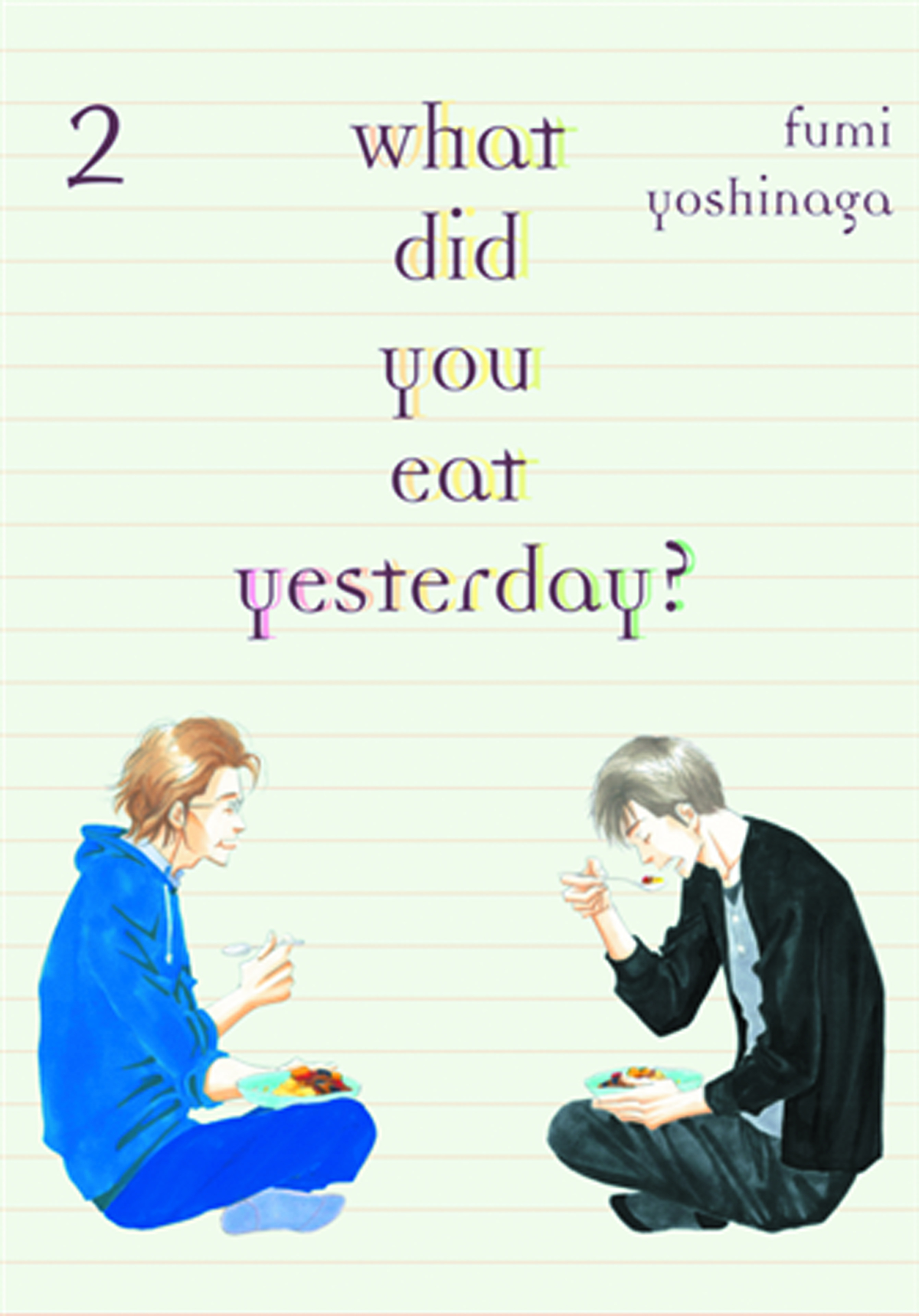

It's a manga about a gay Japanese couple in their early 40s, centered around the food they eat. I bought it,

1) because it got recommended with the highest praise, from a friend of mine who actually knows the genre (hi sunriseline!)
2) because it sounded interesting
3) because I knew it would mess with my friends expectations of what I'd buy.

In describing "What Did You Eat Yesterday" to people who actually read the genres in question, I say I like the manga (I keep typing comic) because of the strong character work. And while that's not wrong, those characters, a volume and a half in, are why I'm there, saying "strong character work" feels like a bit of an easy out. I feel like saying "strong character work" is not giving the manga its full due. The pencils are meticulous, the asides are well placed, and the sketches of supporting characters are precise and evocative. The two men in question each have flaws, but also personalities that would interact well. I confess to not being finished with the second volume yet, but what's there so far feels authentic. The descriptions of the food and preparation of dishes reveal character, but also make me want to try my hand at cooking. It's a great manga. If it is not too long, I will purchase it all, like I have with Pluto.

But the more I describe "What Did You Eat Yesterday", the more I feel I'm stepping around the fact that I don't have a vocabulary to talk intelligently about the genre. This is a problem, because in comics, black and white slice of life works are things I actively avoid, much the same with Young Adult material. I have no trouble, when I'm running my mouth of course, passing judgment on those things. And I've got a friend on Twitter (hi Katie Locke!) that loves YA material and will often make the very reasonable point that if I don't read the genre then it makes it hard to pass judgment on its effectiveness or legitimacy as such.


In talking about YA, or Yesterday, or b/w slice of life (hi Adam Witt!), when I am forced to praise them, I talk only about fundamentals. Do you have a plot that's interesting? What motivates the characters? Are the characters compelling? And so forth.  Which, again, feels passing over something politely, or not giving the idea its full respect. I feel my omission.

I can say oh man, China Mieville's a great writer, praise those same fundamentals, but with infinitely more enthusiasm. China Mieville does cool shit. There's monsters! And Serious Ideas! And nightmare fueled panic, white-knuckling an entire final quarter of a novel. I don't have those same things to talk about with ...Yesterday, YA or, b/w slice of life. It is hard to get away from the judgment in my head. To indulge my judgment: What overarching plot is there in "What Did You Eat Yesterday?" Someone, find me some. Really. Go for it. I'll wait. The plot appears to be "a Japanese couple who is gay navigate the labyrinthine code of Japanese formal niceties. Also: Every chapter, a new food dish." That's it.


That's what makes my pleasure in reading "What Did You Eat Yesterday" so striking. I believe I'm having a Nixon goes to China moment here. Enjoying "What Did You Eat Yesterday" and trying to talk about it reveals just how provincial I am. That's the opposite of the how I present myself. I'm looking at my bookshelf right now, it's Faulkner to Foucault to Fuentes. I'm very cosmopolitan. I promise.

(All three Serious, Important Male Authors. I'm aware.)

To say I like "What Did You Eat Yesterday" as a palate cleanser also feels like an omission, a sly insult, as if the stories are not a complete meal on their own. This is a long way of saying I took a chance on something new, and like all great media it rewarded and challenged me in equal measure. I don't know how to talk about this stuff and at bottom, I really ought to.


Been on a Danger Days kick, and while I'm pretty sure I've used Summertime before, I don't believe I've used Vampire Money. Allegedly, a song about turning down a spot on the New Moon soundtrack, and with an opening stolen from Ballroom Blitz. One of the best songs on that record.

Friday, January 24, 2014

Five Perhaps In Some Cases Somewhat Insufficiently Stressed Reasons We Should All Be Terribly Grateful To Miéville


When I looked around at the "best of 2013" material for comics I found one glaring omission: Dial H. Since I've never written a short list before, I figured what better way to show a deep and abiding love for a product than a hastily compiled thing that takes 30 seconds to read?


1. Traditionally conservative DC taking a risk.
In a relaunch that started out super weird, not only in terms of creator departures and editorial edicts, but also in that there was a no joke supernatural romance comic and a war comic (both concepts Vertigo would retry), Dial H was the strangest one of them all.

When my friends first heard about it, they thought "Oh, DC must hate Miéville. They gave him Dial H." Quite the opposite. He wanted Dial H. Before the relaunch, Miéville accepted a Swamp Thing gig, but that was aborted because the toys were being brought back over to the DCU and Geoff Johns needed a splash reveal in Brightest Day. There was a story in Hellblazer #250 as what I assume was a consolation. So, after the new 52, DC gave Miéville's pitch a shot.

I'm not aware of a higher profile creator relaunching a lower profile title at Marvel or DC recently. Mieville has won most if not all of the major science fiction/fantasy prose awards available to Westerners, and Dial H is best known as the butt of a joke, or as "what DC superhero team is not even D-list?"


2. Dial H was co-starred by a woman who was old and awesome.

Yes. I know. Usually old and wizened characters stand around, look stodgy and then occasionally when a big fight comes, show how they earned their beard. Dial H's lady (Roxie Hodder) did nothing of the sort. She was actively saving lives, appearing in the comic as a major character that did shit, articulated herself well, had opinions and kicked ass.


Also? Sex between two people that wasn't 30-something Bernini sculpture and 30-something Bernini sculpture.


3. Dial H stayed away from current DC continuity.

DC gave (or more likely outgoing Vertigo founder Karen Berger shielded the series from editorial edicts) Dial H enough rope to hang itself with and only checked in when literally every single new 52 comic had to have some major hero in it and even then Miéville made it work with panache.

For fans who wanted a "plays in its own corner and needs to read no other comics" treat, Dial H did that to the hilt.


4. Dial H had a story for adults.

Mainstream American superhero comics are read mostly by people over the age of 30. But hardly ever are comics written for them. There's things that don't insult our intelligence, by and large, but there are hardly ever comics that actually treat adult readers like adults.

Dial H did that. The story was confusing, presented themes like identity, paralysis and inspiration in a way that didn't explain everything at first glance and trusted you were along for the ride. It managed a neat trick of extracting a childish degree of wonder and inspiration out of readers who were supposedly jaded enough to know better.


5. Dial H #13

Dial H #13 is a jewel in the crown, though. I compared it, privately, to All-Star Superman #10, which is a high bar to clear and it probably doesn't.  What matters is that there's a bunch of tricks Miéville pulls in this issue that went largely unnoticed or uncommented on by comics criticism and this whole listicle piece is at best a flimsy veneer for drawing your attention back to it. The focus of the issue was the Dial Bunch (no really, that's what they're called) on the run, in a world with sentient graffiti. Now alone, the phrase sentient graffiti ought to be enough, but the way that these things interface with the story (and advances the plot) is genius. But that's not why I adore Dial H #13, if I'm honest. I adore Dial H #13 above any other comic released last year because of the following single panel origin of Unbled, the Demon.


The entire issue is a celebration of the inspirational possibility of superhero comics, but that single panel stuck out to me more than the constructing tricks, the earnest proclamations of heroism, and quick sketches of future possibilities we'll never see.

(The first two images are pencilled by Mateus Santolouco, the second two by Alberto Ponticelli, the fifth by David Lapham and the sixth by Alberto Ponticelli again.)

Saturday, February 19, 2011

Late! Crazy Late!

I suppose this is as good a time as any to announce Subsidized Sincerity is going to a Tuesday, Thursday, Saturday schedule. I'm still going to think of it as Monday, Wednesday, Friday but there's less, say noise, on the internet Tuesday, Thursday and Saturday, so I hope it will sit better in the immediate future.

I've been rough on the Dresden Files recently. Admittedly, the third book (Grave Peril) seemed to lean hard on the “darkness is bad, light is good” that's kind of simplistic. There was a guy from the Church (Michael) who has 2.5 kids, works as a carpenter, who carries a sword that may be a nail in the cross of Jesus and a priest that's old, reliable and apparently, churches are safe havens for the people suffering from vampire or demon attacks.

And yes, I'm going to contrast it again with the most recent book by China Mieville that I read. It's called King Rat and apparently, it was his first. It shows. He uses the word impossible too much in describing the titular characters abilities, but what stood out to me was how both books looked at darkness.

In the Dresden Files, the darkness is something to feared. Vampires or fairies or whatever lurk there. In King Rat, the darkness is sheltering. The darkness is useful. The darkness is home.

In the Dresden Files, purity is a thing from which power can be drawn and is spoken well of. There's pure white flame which Michael calls on to battle the dark, dangerous vampires. (At one point, a vampiress, in order to flirt with Michael, touches his arm. She erupts into a “white flame,” and is thrown off of him.) In King Rat, purity is abhorrent. “Purity is a negative state, and contrary to nature.”

I've read four five six Dresden Files books in rapid succession. Mieville's work, less so. Bottom line: Mieville is fucking complicated. Butcher is not. And that's only a partial knock against Butcher. I've laughed far more often at what Butcher puts in front of me.

In Summer Knight alone, we're talking about a book where the police lieutenant takes a chainsaw to the back of a troll's knee (an old Chicago tradition) and then to the head of a plant monster, a book where the day is saved by tiny pixies with box cutters flying out of a vase screaming “In the Name of the Pizza Lord, Charge!”, a book where Harry Dresden throws a cup of cold water on his erection to break out of Fey trickery, it's a book where, here a neutral party to the character describes how everyone else sees the character and it's fucking funny because more of it is true than false.


I love that moment.

I resent Butcher's attempts at epic because I like the magic PI story and I dislike conventionally epic storylines, a three way violent orgy between wizards and fairies and vampires. I like Mieville's attempts at epic because, motherfucker, they feel epic. You've got goddamn squid gods fighting mortals for control of reality using their imaginations as their weapons.

Now that's what I call epic.


Tonight it's Ballots/Stones by Hostage Calm. The recurring lyric is this, and it's a doozy: "Did you cast your ballot or a stone?"


Friday, January 21, 2011

A Storm Front In New Crobuzon

Perdido Street Station is unfamiliar. Storm Front not at all and I like both for those reasons.

Storm Front flaunts its influences on its first chapter, even in its first paragraph. The first paragraph is about how the mailman usually announces himself. See also: The Postman Always Rings Twice. Within the first chapter, we learn working wizard Harry Dresden is a) behind on rent and b) received an evasive female caller that wants to meet him about a missing persons case. If this sounds familiar to you, it's because it's basically the beginning of every noir story ever.

You get introduced to, next, a no bullshit police lieutenant, who needs Dresden to investigate a fresh crime scene. Surprisingly enough, she's a woman, Karrin Murphy. By the second page of the second chapter, Dresden's opened the door for the woman and called himself old school.

By the third chapter, he's been told by the Mafia to keep his nose out of the case, that the mob will “double” whatever the city is paying him to take a vacation for a couple weeks. He says no. (Of course.) There's a sour pub owner that Dresden is on a first name basis with and a voluptuous woman that wants something from him that lets Dresden peek down her shirt in attempt to get information out of him. (After a quick glance, and only that, he reiterates how old-fashioned he is.) He has to meet a vampire, cross basically all of the people who trust him in an attempt to solve the case.

Would you be surprised to find out that the police lieutenant is having her unseen bosses (Commander Fairweather, in case you were wondering) breathe down her neck or that one of the women is playing Dresden? No. No you wouldn't, because it's all shit you've been before.

It's not like the magic is much more astonishing. Maybe you'll surprised to hear that he brews a love potion and doing so blows up in his face? Mostly, magic accounts for the high octane fights and hijinx. Look, a talking skull and an absent-minded fairy to trap!

And yet, I blitzed through Butcher's paperback in two evenings and I'm stoked for the second, third and fourth books. (I suspect by book five or six he's going to be repeating ideas out the ass.) I mean, yes, I'm a total sucker for the genre and this one gets me right in the sweet spot. There's enough hijinks to keep things moving and there's enough twists (not that they're telegraphed, but it wants to be a noir so bad and I know what to look for) that it keeps me happy.

Compare:

Within the first chapter of Perdido Street Station, we see the city from outside in the first person, from a character that's not named or described, on the run from something, and headed toward a brief hope that it might be whole again. You arrive in the city from the first chapter, as you approach it, from the perspective of an outside on a boat coming into the city, hearing only rumors from the nebulous narrator. The first two sentences: Veldt to scrub to fields to farms to these first tumbling houses that rise from the earth. It has been night for a long time. Right there, you get a clear sense of coming closer to a city center and that the narrators been traveling for a long time, whether hours, days or weeks, who knows.

In the next chapter, we meet an adorable couple, a female artist (Lin) and a youngish sorcerer (Issac), waking up with each other in their apartment. They wake up together and make breakfast. Issac, the dude, is predictably sleepy and wants to go back to bed. Familiar enough, right? That's when you see, slowly, that Lin has red skin, four pairs of insectoid legs and can't speak, so instead signs. That's before she opens up her head and reveals mandibles, not to mention, tiny delicate wings and that's before she and Issac start having sex, the anatomical possibilities of which Mieville leaves up to our imagination.

Lin, then leaves, because she has to go to work. Again, not really surprising, until you find out that she's going to meet a mysterious buyer that she's certain Issac won't approve of. It's a lucrative commission to do portrait of the lord of organized crime in the city. Yes. The woman gets in trouble and chooses it and, for the record, stays on top of it, until Issac fucks it up. (Not that Issac would know, which I suspect is another theme.) Other main characters are an underworld go-between, a Hutt-esque bartender that the regulars are familiar enough with that they cheerfully order from him.

Let me repeat the comparison: In Storm Front there's a femme fatale that appears in front of the wizened world-weary male narrator and there's hedging. It's probably on the level and it's probably nothing. (Of course it's not, but anyone who likes noir is not everyone who might read the story.) In Perdido, a young female decides she's going to take the chance of working with a crime lord because it will set her up for life and she'll be able to make whatever she wants post-faco and there's no hedging: This shit is dangerous. For Dresden it's enough to get by, for Lin, it's about getting free.

And...after reading Perdido, I wasn't psyched to read the next book in the series. When I finished Storm Front, I was, and this will not surprise you, psyched to read the next one, which, of course, I don't have. And it wasn't because Storm Front had a happy ending and Perdido ended with more movement and running, either. Perdido was exhausting, whereas Storm Front was invigorating. I knew, from the first paragraph of Storm Front, what I was getting into. Perdido, less so. I couldn't go on autopilot for the book or use my knowledge of the genre as a crutch to catch the little references. It surprised me and terrified me in equal measure, and pretty often to boot, so I know I'll be going back to Mieville eventually.

But Butcher? Like popcorn, I want more and I can handle it, right now.


Today's is the Out_Circuit's Across The Light. It has little or nothing to do with the thing, except that it's what I listen to when I need to chill out at night and I just want to be a little ambient. Crossed with Paul Duffield's Signal, I'm de-stressed and ready for sleep.


Wednesday, January 19, 2011

Perdido Street Station, Empty.

First things first: Amazing book. Like Bolano, I feel like there's a blast radius after the book finishes. It weighs on me and so I went to Butcher's Storm Front and was reinvigorated. The “new weird” designation makes sense for Mieville, as there's usually a new strange creature around the corner or at least, at every chapter.

A bit spoiler, but something that's fun. The city's leaders are talking to the Ambassador of Hell, in a private chamber, in which they require spell protection (which has a very limited time frame) to even enter. They are standing in front of the seated Ambassador, who is dressed in a natty black and red suit and speaks as a charming human negotiator would. If they blink involuntarily or stretch, however, for a brief instant, the illusion breaks, and the room is viewed as a festering, fiery pit of shrieking souls, in which there is a lot of screaming and the Ambassador is revealed as a hyena headed grotesque creature.

But: They can hear reverberations of the screaming, screeching words the Ambassador is saying. The Ambassador and the group can't come up to a deal, so the group leaves and as the group is going back upstairs to the normal part of the building, one of them realizes something: Guys, I don't think the screaming voice was the reverberations. I think the normal voice we heard was the reverberation.

Holy shit. Instead of mankind piercing the illusion of sweetness of devils, as so often happens in fiction and literature, the sweet voice is what the humans convinced themselves of to ignore the voice they believe to be true, the shrieking and screaming. Smile a moment: What other horror can you convince yourself isn't so bad?

It's that kind of reversal that endears me to Mieville. Mieville's characters and writing can be elegant, stubborn, grounded, ornery or dropping huge, poisonous hints to the reader, something that sticks out for a page, like a secret between Mieville and the person that pays attention. Also, he's smart and super liberal, so that doesn't hurt, either. This a committed Socialist, not a fly by night operator that fucked a co-ed with a poster of Che Guevara on their pasty, mauve dorm wall. A guy who, in the year 2001 received 1.2 percent of the vote as a Socialist candidate for the House of Commons.

I've been working on a review that says something to the effect of: Kraken was Mieville having fun, after what I imagine was a grueling writing process of The City & The City, since Kraken has so many of Mieville's favorite things (and completely ridiculous bullshit) in close proximity. He's got his two male leads running around with Star Trek props, which, thanks to the power of magic, have transmuted into working phasers, a cephalopod MacGuffin, gimp mask Nazi assassins and the crux of the book being decided by who has most powerful and sprightly imagination.

Perdido, then, comes a decade prior (Perdido, 2000, Kraken, 2010), and incidentally, is weird and no fun. It's a scary book. Sure, there's a circus of strange, but that's aqs much to show Issac's state of mind than actual levity. Case in point: Lin ends up brain damaged thanks to the beast that Issac unleashed, Issac pissed off everyone who has a powerful organization in the city, the person to whom he promised flight and there's another woman with Issac, who is not brain damaged.

And now, they're disguised and leaving the incorporated limits, weighed down by Lin, who is now significantly less competent, Issac's guilt and everyone's culpability in a plan that saved New Crobuzon at the cost of a basically innocent human life, the lives of their assorted friends and the ire of every power player in the city.

On the plus side, our heroes (???) met a for real God, the cryptic, nonsensically verbalizing Watcher, a spider of titanic proportions, who'se plenary existence is very much put into danger by the terror of the last half of the book, saved a city, even if they never can take credit for doing so.

I'm not sure what that arithmetic shakes out to, but I know it left me cold, in the best way. Luckily enough, I had Butcher's first Dresden Files book to start, and that's where I'll pick up in the next piece.


Since we discuss hell in this, a little heavy metal feels appropriate. And by a little, I mean five minutes worth of some of the finest vintage available. Here, have Dead Fathers Wading in the Bodygrounds, by Trap Them.

“We're the healers, we're the providers, we're the shelters and the badges and the sirens and the cadence and the martyrs. We are the old graves digging the new.” Good old fashioned doomy metal, nastier and with attention to detail. This is not supposed to make you happy. This is supposed to dump a half empty gascan on the rage inside you. Put your horns up, child, and bang your head.

Monday, January 17, 2011

Frankenstein To Rome By Way Of Perdido Street Station

This one's late. Here's why: I'm not doing these with a buffer. It's my fault and no one else's. In response to and because of the fact that I'm going to be away from the Internet for the weekend, this is the first of the three pieces that will be up tonight. Call it the China Mieville Triptych. I have another two books by Mieville with me, so I don't see his influence becoming less pronounced on me, but also, because the other book I read, Jim Butcher's Storm Front, (the first book of the Dresden Files series) also has magic and a cynical outlook and was sooooooooo much quicker to read. That doesn't necessarily mean it was better. Anyway. This one is a comparison to Frankenstein, which I have chosen for my next A Theory Of book. What will be Wednesday's will be whatever Mieville I remember, on its own. And what will be Friday's is Perdido Street Station compared to the first Dresden Files book.

The other reason why is because my flights to Rome ended up arriving...eight hours late, I just went to bed Monday night and didn't have internet access until today, Thursday.

Which means I need to stitch this thing together, using whatever I've been reading and whatever I remember from Frankenstein. As you might have guessed from the title, I've been working my way through China Mieville's Perdido Street Station, a book about a lot of things, but also about a far too curious scientist meddling with things he shouldn't. In Frankenstein, it's, well, the scientist named Frankenstein, shooting life into a waiting creature he curated and created, using miles of blood vessels, discarded brains, body parts and whatever else he could find. In Perdido, it's an absent minded sorceror called Issac, living in a cosmopolitain shithole called New Crobuzon feeding a curious recreational drug to a caterpillar that blossoms into a soot-black terrifying creature of the night, which exists in multiple dimensions, can cut through armor like a knife through a receipt, flies adroitly and drinks the dreams and knowledge matter of its prey (anything, including apparently, a very Hell, who'se ambassador refused overtures to help the city.). Issac didn't know that going in. He just kept the caterpillar around because it didn't eat normal food and he pitied it.

Perdido and Kraken have a number of similar plot elements (along with The City & The City.) There's a skunky/manipulative head of an academic department who seems haughty and ends up being evil and behind one of the growing threats. There's a failed strike against a overclass (not present in City, IIRC). Authorities are at best, well-intentioned and ineffective (well-intentioned in City and Kraken, evil in Perdido and ineffective against the growing threat in all three) at worst, careless, responsible for the threat and ineffective (the trifecta is in Perdido.) There's also a cobbled together resistance which is startlingly effective against the threat (Kraken, Perdido).

In all these though, the cobbled together bits work the best. Apparently, trained militia can't hit the snake moths any of the time, but our heroes, only a couple of which have any kind of history with pistols can, 2/10 times. Oh shit, there's also a member of the underclass, ignored and underestimated by their masters, who rise in ways that save our heroes' ass. (Kraken, Perdido, maybe City) Honestly, when I read the Scar next, I am putting money on the idea that there's going to be a rising underclass member, an evil academic, and negligent, myopic authorities.

That said, Dr. Frankenstein could be a villain in a Mieville book: He brings life to something he created and then treats it like a thing without autonomy. He's also evil, but in a way that doesn't see himself way, or at least bad. Frankenstein feels a lot, lot denser. The type is smaller and is spaced even more shorter than Perdido, but I think the expectation of Frankenstein weighs on me.

There's another bit about Frankenstein that Mieville doesn't have. (Mieville's also not one of the celebrated authors of all time. That's a thing.) Frankenstein, or at least the first forty-nine pages of it I've read is immensely quotable.

“I shunned my fellow-creatures as if I had been guilty of a crime.” Gives you an idea of the guy's state of mind as well as the fact that he might in the back of his mind, thinking about what he's doing is wrong.

“I shall commit my thoughts to paper, it is true; but that is a poor medium for the communication of feeling.” This might be Mary Shelley in a self-deprecating moment. I can see her writing that with a sly smile.

“A human being in perfection ought always to preserve a calm and peaceful mind and never allow a passion or transitory desire to disturb his tranquility. I do not think that the pursuit of knowledge ought to be an exception this rule.” That last one was on page 44, just before Chapter Five of Volume One and just before Frankenstein flips the switch on his now famous monster. That, kids, is how you do foreshadowing.

Song is called The Disarming Smile, by the World/Inferno Friendship Society. It's from their new record, which is a lot...jauntier than I would have expected. (Except for the track about a friend's suicide.) Think of what the band would be whistling as they're walking away from a crime sporting a shitfaced grin and that's about it. Not exactly new territory for the band, but less agitated. It's clear: the band knows something you don't.

Think more Hothouse Flowers and less Brother of the Mayor of Bridgewater and you're about there.

Wednesday, December 15, 2010

Kraken: Examined The Day After I Read It So Maybe I'll Be Embarrassed Later?

I finally tore into Kraken by China Mieville on the flight back from LaGuardia and it's, honestly a very China Mieville-y book. It's basically a Cthulu story, with Mieville bits thrown in. Two of the characters run around with a working phaser and Star Trek quips and while I'm not going to reveal the ending, if you read Kraken with the understanding that Mieville is very much a Marxist author, you can figure out an important trope that he counts on again and again within the book. It'll ruin a couple surprises, but not the last couple ones.

But the Marxism is secondary at least, to the point of this update, which is: I think the book is fantastic, I got a paperback copy in Munich, after I took part in an anti-fascist demonstration and it's worth buying whenever it comes out in the States, but....

The ending. Fucking hell. That ending.

Okay, past here are spoilers.

As in, the book is cool, the deeper it goes into it, the more I wanted to turn the next page to see what happened and the things that end up happening are epic and brilliant. Spoilers actually past here.

I could talk about the characters, but I'm going to be vague, one, because I have a limited amount of time and two, I'm not sure Kraken has come out in the States. ANYWAY.

Now, there's a loose coalition of good guys, fighting bad guys (ancient lurking evils) by the end. Who would have thought? But, to win the day, night and life on Earth forever after, the hero has to fight with a would-be reality author to rewrite reality for the entire goddamn world if not the universe to prevent apocalypse, bringing existence and counter-existence into play, in a battle of who'se pen is fastest and who has more power. It's sweeping, it involves the Big Bad at the end who has Minions and unseen tentacles. It's pretty trippy and sick.

But it's a fakeout. There's another Bad, a smaller, more insidious Bad, that lurked under the noise of the book and the deafening screams of London in the baudy, visceral throes of Apocalypse and it turns out, this Bad wants to use a time-Molotov to erase evolution and the hero has to beam himself back to the first scene in the book to prevent this from happening and honestly, it doesn't really matter what happens after that. Something is erased, but, my issue is not with that, my issue is that...man, that was a final twist that didn't out-twist the huge crescendo.

It wasn't a bigger twist. The stakes weren't higher and it didn't seem more important. And I don't think Mieville is pulling a Tolkien (remember, there's a much, much smaller Bad that's defeated in the Shire), because it wasn't liked Mieville lured me into a false sense of security. There was a huge fight and the the hero realizes, oh shit, something else is up and goes off to that. It was always meant to leave me breathless. Alternatively, the finger never left my throat.

Put simply, you go from one of the foremost creatures in the history of the magic world absorbing the power of the gigantic monster squid to insert itself as the arbiter of magic for eternity...a guy with a grudge against evolution and a homemade time incendiary? I found myself going OH SHIT YES OH SHIT YES OH SHIT OH SHIT OH SHIT WAIT WHY DOES HE HAVE THE WHAT AND OH, WELL, OKAY, I GUESS?

Spoilers finished.

Kraken, I think, went for just one more trick and it simply wasn't more impressive than the one it followed. Then again, when you have doomsday cults of all stripes and perspectives, a range of assassins that are colored in neon and any other hue you can think of and guys running around like Kirk and Spock on Star Trek (not to mention, somehow working in phasers actually working and magical teleportation into the story) trying to stay one step ahead of the doomsday cults and assassins, holding apocalypse back, you've probably already won.

Kraken was a page turner, and like The City and The City before it, I look forward to reading it again. Also, I finally finished 2666 last week, too. That, I promise you, will be a story for another time.

Say, Monday?


Again, time is limited, so I went for the first British artist I could think of and it ended up being the Pipettes. This is the sole Pipettes song played by Kieron Gillen at Thought Bubble 2010, if I recall correctly and dancing to it felt like I had finally done something right. To approximate the experience: Listen to it once on a normal volume and listen to it again cranked up. When you hear it cranked up, that soaring vocal track becomes sublime.

Creative Commons License
This work is licensed under a Creative Commons Attribution-NonCommercial-NoDerivs 3.0 Unported License.