Showing posts with label serious. Show all posts

Friday, March 3, 2017

Trap Them And Queer Them

Donald Trump won the election. Serious political commentators ignored the possibility or gave it no better than a 35% chance. Then President Trump won. It wasn’t quite Dewey Defeats Truman, but it did happen and it’s where the country is now.

Since then, news about grotesque abuses of power and appointments of actual Looney Tunes to federal office dominates the papers and television.

Election night, I expected to feel rueful and happy for my friends inspired by Secretary Of State Clinton’s campaign. I’d never seen so many of those friends excited on the morning of November 8th, and I figured Secretary Clinton’s victory was inevitable. So the next evening, I marched and chanted and went home. I held up a sign saying I was queer, bloody but unbowed. It did feel like that, I did feel like whatever we’re calling culture now landed one really good punch, but shit, I was still here, and it would require more than one really good punch to knock me down.


(Image above from Monkey Defies Gravity.) Trap Them played Subterranean six days later. I’ve got a long history with Trap Them, and I count on the band for spectacular live shows, due in large measure to vocalist Ryan McKenney.  Whenever I see Trap Them, McKenney goes off, whether it’s jumping into the crowd or perching on top of the barrier like a vulture, eyes set to kill, forehead oozing blood.

McKenney broke both heels in Europe (and one ankle) and according to the show I saw on YouTube, did the following European tour in a wheelchair. It was wrong to see McKenney confined to a chair, gripping that microphone like a neck of a man who never saw McKenney coming. Trap Them performed admirably, but when the band’s most dynamic member broke both his heels, it’s unlikely to result in an engaging set.


(Image above is from Metal Injection.) I almost didn’t go to the Chicago date. My brain was wobbly and my head swam if I moved it too quick. It’d’ve been prudent to lie down and stay home. I almost did, and then saw the earplugs I’d been hunting for. Fuck it, I said to myself.

My brain evened out and my head stopped swimming by the time my commute to the venue, Subterranean, was over. Subterranean is a three story walkup. There’s yet another floor of Subterranean to get backstage. How did Ryan McKenney get up those stairs?

I waited. Like Rats was unremarkable, and Yatuja was technically proficient enough that I’ll remember their name, but anything else about them is gone. Sorry, gents. An admittedly generously poured vodka cranberry later, and Trap Them was finally sound checking.

No sign of Mr. McKenney. I figured he’d be on the first floor in a wheelchair, and then someone from the venue would carry him up the five or six steps from the audience floor onto the stage. There’s another way to get onstage and that’s down one flight of an industrial metal spiral staircase from backstage. But imagining him going down those stairs was ridiculous. How would they carry a person in a wheelchair down that spiral staircase?

They didn’t carry him. He descended alone.

I saw McKenney push himself cast-first down each step of the spiral staircase. He wore casts on his feet and kneepads. He crawled from the bottom of the staircase at far end of stage right to the microphone stand. The venue would’ve carried him. His bandmates would’ve carried him. He crawled.

He performed the 45 minute set on his knees, thrashing around, using whatever he could for support and maintained the baleful, wrathful presence he was known for. He flung his body like he hated it, and yeah, broke open his forehead mid set. I’m focusing on Mr. McKenney and not the rest of the band. They played well, if unspectacularly. I think guitarist (and songwriter) Brian Izzi added a few flourishes on the pre-Blissfucker material.

You’ve read enough of these know how this one comes together. Life landed one real good punch on Mr. McKenney, and he was stubborn enough to cancel zero shows. I began to despair and Trap Them reminded me I didn’t have to. And I needed to see Trap Them and Trap Them specifically. I needed the music (a combination of Entombed and Hot Snakes) played much too loud. I needed to see Ryan McKenney’s wild eyes and him performing through what I presume is meaningful pain.


(Above image from Flickr user Morten F.) I somehow got the idea my queerness is incompatible with my love for guitar music. I believed (at the cost of impugning one of my home cultures) that I really ought to listen to more, well, queer or allegedly queer friendly artists. During that seven day period, what I saw from queer friendly artists was variations on the phrase “my idols are dead and my enemies are in power”. I understand the fear. I understand the despair. But I came to fight, not resist. McKenney came to fight too, even when no one would blame him for a less evocative performance.

It was at most 45 minutes. I don’t recall an encore. Before I left the venue, I talked to Mr. Izzi, who said that we all needed this show. He was more right than he knew.


Youtube won't load properly, so instead, have Chris Maggio recording drums for Darker Handcraft. He's incredible.

Sunday, September 25, 2016

Come Off It Jason Pettigrew

The web never sleeps, which means the news/content cycle never does. "Jack White Has Dinner, Uses Napkin" isn't what a seasoned reporter would call a get.  -Alternative Press Editor In Chief Jason Pettigrew


I'm not enamored of Jason Pettigrew's half of the feature with Scott Heisel about web music journalism. I think he's disingenuous in the spots where it's not overly bitter. In his defense, there are legitimate things to be bitter about. Posting a tracklist and an album art counts as news, for someone, and "link-whoring duty" is an actual phrase used by Gawker. Reblogs of wacky internet videos poison the well, but keep a certain, ever declining number of readers engaged. Pitchfork reviews of punk and hardcore records leave me foaming at the mouth. Careless reviews of pop superstars make me question my sanity.

Pettigrew longs for the days of the noble gatekeeper, when a person had to be vetted by an authority before they could write about music for a magazine. And now, he says? Everyone's got an opinion. Well, sure. They always did. Now they can express it publicly and people might actually look at it. He aches for the days when access was limited (and this part is worth repeating) and he had it. But now, it's not and Good Lord, one does not have to first be approved of by Creem Magazine before writing or hearing the music. The horror.

"the days when gatekeepers (read: music press) were given the responsibility for having well-informed, articulate opinions regarding the material they were to wax wise about...All it takes is one sticky-fingered, disgruntled intern or one unscrupulous person to receive the wrong package...and the introduction of a band's new work belongs to the masses."

Mercy, sir, a person could be introduced to the record by listening to it themselves without the precious context of whatever the writer decides to copypasta from the press release, a quick Google search and a list of cliches too long to name? I am mortified. (For best results, read this paragraph again in Foghorn Leghorn's voice.)

Admittedly, that's a disingenuous summation of his argument. Those days of gatekeepers being paid a maybe decent amount of money to have opinions is gone, and we lose that, while we gain, and this is crucial, immediate access to the work itself, rather than sitting around for the intermediary of the music critic's judgment. I'd love to be a professional music critic, admittedly. But, everyone listening to it alongside each other means more people get the experience sooner. And our judgments were always a half measure towards other people giving an album their attention.

At bottom: I think this development sounds fantastic.  I don't think improving a person's filter on what they read is a bad thing. Shit, I think you should be doing it anyway in every aspect of your life. Democracy means there are more critics, yes. But those experts still exist. They haven't gone anywhere. You can still find them. And some of the critics today will be the experts of tomorrow, as they'll keep writing, going to concerts and turning over songs in their heads. Democracy also means you have to do the legwork to decide what opinions and beliefs are most valuable and useful to you. You can still get those opinions from somewhere else, if you as a consumer don't want to do the work.

Two other points: 1) Pettigrew's not required to read the ramblings of the imaginary, but almost certainly existent college freshman who is obsessed with Nirvana. 2) That imaginary college freshman Nirvana obsessive? That was us, once upon a time. Nirvana might not have been my or your focus, but those ramblings could easily be his, mine or ours.

There's a lot of resonant scenes in Almost Famous, but the one where Lester Bangs offers William Miller $35 for 1,000 words about Black Sabbath is instructive. Here's the catch, Pettigrew aches for the time when he could be Lester Bangs, dispensing sage advice and long assignments to reporters or freelancers. Those days of access and using that access as a megaphone to which the kids will flock are done. They're not finished, certainly. The Rihanna airplane debacle proved that. But, like a knife to the armpit, you're going to bleed out and die and Pettigrew sees that coming.

Here's to whatever comes next.


This is years and years old, but I kept coming back to it privately. I didn't post it because of cowardice, but now that time's passed, it can finally exist outside my own head. As for this choice of song, well, "fuck the glory days" feels pretty appropriate.
 

Sunday, March 8, 2015

Stuttering.

It was Brian Wood that got me to think about this directly again.

I don't know what your experiences are with this. I don't know what your experiences are with anything similar or more socially stigmatizing. If I offend you, it was not by design. Before I start, the usual prostration about how of all the ways in which our one life can be made more difficult, a stutter is preferable to many other things.


I stutter. It's not fun, but it's livable. My friends got used to it. Now, I run roughshod over the sentences I speak. I suppose it goes without typing that I allow myself to stutter obviously. (Some people hide it or get it ironed out. To each their own.)

Thanks to the stutter, I had to discover a vocal rhythm. That, I now believe, was the beginning of my "voice." When I'm on, my sentences sound, deliberately, a certain way. Lots of commas, some single word sentences. In other words, plenty of places where I can pause for dramatic effect or if the engine of my voice cuts out.

I learned a lot of things from managing the stutter, some good, some bad, most useful. If given a choice, I'd excise the stutter. I hate it, but the task is serenity.

If I sound frustrated, it's nervousness compounded by an actual and not figurative inability to speak my desires. Even when the words are right, I still can't vocalize them. The issue is not desire and fear intertwining to compel the speaker to choose to speak multiple words simultaneously, but having nothing come out at all.

It is as if all of the lubricant in the gears of your voice disappears without rhyme or warning. Or, most damningly, another impregnable syllable in the middle of the most unremarkable sentence.

The rest is merely embarrassing details: I have pride, the stutter doesn't allow it. Stuttering in front of people I'd like to stand up straight in front of is rough. I imagine pity in their looks, and I can't stand that. I doubt the stutter has cost me lovers or friends, but my mind uses it as an excuse to believe the worst. The stutter activates my shame, which more powerful than it should be.

I don't know if I've ever wrote about this. I imagine I must have, I've littered the internet with writing, but looking at the publish button feels fresh and relieving, so I suppose I haven't. How have you been, though?


For some reason, I don't find Elastica's "Stutter" terribly insulting. I think it's because I understand I believe the singer (Justine Frischmann) is talking about her boyfriend (Damon Albarn from Blur?) being tongue tied in her presence, which happens to everyone. That, and probably residual love for Phonogram. Anyway. Above image from adsoftheworld.com

Monday, December 29, 2014

Purity doesn't absolve you. (cleaned up and crossposted)

"They were not working to save our country," writes David Simon. I disagree. What makes Bush, Cheney, Rumsfeld and that gang frightening is that they were trying to save our country. The law doesn't require that group of people to come to torture as their instinct, the law only requires that they came to it at all. I believe Bush, Cheney and Rumsfeld led a group of cowboys and zealots towards a war, and committed war crimes because they believed it was necessary for the survival of the United States.

The sincere belief that it was necessary for the country's survival doesn't absolve them of what they did. The frightening thing is that Bush, Cheney and Rumsfeld are still human beings. They hug their kids sincerely. They're grandparents that want to make sure their families have good lives. In other words: They're normal people (a given value of normal, I'll grant you) and the trick is normal people can commit atrocities.

I don’t care if Bush, Cheney or Rumsfeld is a torturer in their hearts. I do care that they ordered and authorized torture. That’s the only way this matters. I believe they’ll go in front of God or St. Peter or whomever and say “we did unto those sons of bitches before they could do unto us” and face judgment with a shit grin. You won’t get Bush, Cheney or Rumsfeld that way.

Here’s how you get them: They hid it. They knew it was wrong and that’s why they went to such lengths to justify it and then hide it. Treat them like Snidely Whiplash and you get nowhere. Treat them like men who got seduced by confirmation bias and then said “take the gloves off” when they could have said “feeding a prisoner through their asshole,” and you get ‘em dead to rights.

They should be prosecuted.


There are other versions of this on the internet, but I'm calling this one definitive until I add or subtract something again in a couple days. This seems like a good place for the epic closer I, Stateside by Crime In Stereo. Play loud, get sad.

Tuesday, October 28, 2014

Ignore The Jetsons, Dream Impossible Things

Let's get this out of the way: I doubt anyone reading this at the moment of writing will live to see jetpacks, the way our parents' imagination designed them. Aside from the whole jetpacks shoot flame that will char and destroy your legs bit, the vision of the future is largely understood to be the Jetsons. It doesn't matter that the Jetsons was always highly improbable, it imprinted on the (white) cultural imagination. I must pass over afrofuturism for this whole thing to work.


You have seen this on Facebook. "MAN WHERE'S MY FLYING CAR" and so on into infinity.

But as of October 28, 2014, it doesn't really feel like the future. Unless things get worse, my generation's Selma happened this year, Ebola is back, Russia is posturing on the world stage again and Christ only knows what else will come down the pike with the year 2014 appended to it.

Except, of course, for all the things that watch us from the sky, from the cell phones recording our major moves in our pockets and our social networks recording our minor foibles presumably to be hurled at us when we are cornered or weak. Women get bomb threats for having opinions about videogames.

The future, of course, is always gunning for us. It feels that way in my head.

Except for the margins.

I write this on a laptop computer with 500 gigs of memory, not all of it filled by pornography. I write this listening to a mashup of Aphex Twin and Taylor Swift. It's the mashup that feels like the future. Not in either of the parts, but what that last sentence means.

That last sentence is actually crazy, if given time to unpack it.

1) One no longer needs the imprimatur and recording budget of a big label to make music.
2) Recording technology (and what we define as possibilities for music) has advanced to the point where physical instruments are not always required.
3) The availability of music has gone from requiring a physical copy of the release to a free for all, with almost anything instantly available the day of release, if not before.
4) The ability to manipulate audio that already exists is so unremarkable that it comes standard on a Mac, and similar technology can be found for a steal or a lark on the internet.
5) The ability to record music is so pervasive that it comes standard on a Mac and free versions that do mostly the same thing can be found for a steal or a lark on the internet.
6) The ability to isolate and acquire vocals from a particular recording is available to us.
7) One can distribute what they create for a nominal fee or free, via the internet.
8) The end result is inside a genre that already exists and has a name that fits in our cultural imaginary.

Fifteen years ago, if you wanted to hear music from anywhere else, you had to import a copy of a physical release, which assumes, of course, anywhere else could afford to press it and promote it Today? Troll Soundcloud or Bandcamp for twenty minutes. No promises it'll be any good, but you can hear it.

It may be a shitty punk band you'll be listening to (and I say shitty punk band with solidarity and a smile here) but the option is now available. Something incredible will come. The universe will provide it. Which really means some person will have an obsession and get excited and the technology to create it will exist within their grasp, and the ability to distribute it easily will also exist within their grasp.

As for the content of the music, it's whatever. I never listened to Aphex Twin before, but I thought it was supposed to be weirder and more abrasive than what backs Ms. Swift here. Admittedly, I'm charmed by Ms. Swift's lyrics, even if I hurriedly maintain a jaundiced distance.

It doesn't matter what this mashup is comprised of, what matters is that it can be created, distributed and absorbed.

The takeaway: Music in my lifetime has gone from a thing that I must hunt to find and then purchase to a thing that I can find in a minute and a half if it's particularly obscure and be listening to in 45 seconds after that. Understand that and then multiply it for every other physical medium that yet exists on the planet.

Ten years ago, text messages were becoming interesting. Today? Your phone can record video. Ferguson is Selma, on some levels, but we're different people and we do not require a television channel to broadcast what we see. Now you, dear reader, can find a live feed that's more useful and accurate than CNN. How will that change the way we absorb and weigh information in the future?

Shit, Eleven Names founder Zach plays D&D over the internet with porn actresses. Regularly!

For imperial statements about the future, look to New Scientist or the New England Journal Of Medicine or any military weapons publication. Continuing down this path is a terrible idea, and I did that for an hour until I wisely deleted it.

(The thrust of it: I only have maybe twice my years left again if I'm lucky and the rate of technology currently means that what will be available to consumers the year I die will have existed in a nascent form used by military or random science place for 10 years. Or, put dramatically, the future will end for me in my 60s and it'll take until my 70s for it to reach me.)

And, at least outside of HEY WE CAN CURE [DISEASE HERE] NOW it's hardly ever the technology that is the future, it's what we do with it. The future means women can document the men that harass them using technology available in their pockets. The future means I will still die in fifty years, but I can know and process much more information in those fifty years than my parents and their grandparents were able to.

The future means science fiction is being made obsolete faster than it can be written. The future means everything gets more crowded. Everything gets messier, or we're now aware of how messy everything always was. We are granted more options (if from a fire hose) and more ways of seeing the world. Our ability to make a living on weird or non-traditional jobs has increased exponentially, even if the value of "make a living" is still fairly small. You can express yourself in wild, savage colors.

That last sentence feels too easy. Let me rough that up a little. The future means trans persons may be publicly recognized by my country's administrators while I am alive. When I was a teenager, that wasn't even on my radar, and if it was, I don't think I could imagine their suffrage moving forward at this rate now. Moving beyond the provincialism of my own lifespan, I think we'll be in a better place in terms of recognizing other people in a hundred or so years, even if I only get to contribute to and see the first fifty years of that. I can live with that.

Beyond the old Warren Ellis chestnut "the world's a strange place, let's keep it that way," I imagine, or believe exists a larger sprawl of possibilities at the margins. Look at Homestuck. That's a million dollar property, made entirely by a person from a generation that was native to the internet. Tell someone twenty years ago, you'll see a guy writing a dating sim based on his work on a webcomic, and he'll ask you "what's a dating sim, what's a webcomic and more importantly, no fucking way." We didn't get the future that was in our parents imagination, but what we have currently is something pretty exciting.

We won't get to the Jetsons within my lifetime, I think. But I don't really want the Jetsons now. Do you? How small of a future the Jetsons would be now! How limiting! If all we did was go to the same jobs, but the buildings were taller and the cars smaller!


As I was finishing the major strokes of this at 3 am, I typed in the tags Taylor Swift and it already exists here. I hope and imagine it was Emily or Katrina, from 2010-2011 or a lifetime ago, before the massive needle drop of Phonogram into my life. I don't listen to Taylor Swift or Aphex Twin, but this mashup makes me want to start.
This feels a little too hopeful for me, or I imagine a rebuttal of the terrible things I listed at the top of the article are all still true. It is hard to put a cost on inspiration. It can be done, I am sure, but not by me and not now. I'll say two things. ONE: Access was a major factor in what kept the powerful comfortable and that no longer is true. TWO: Empathy changes lives. What grants more empathy is many different firsthand experiences and failing that, art. I'm a better person for having read Phonogram, but I had to pick my jaw up off the floor after I completed a reading of the Nikopol Trilogy. Borges made me kinder. And if we are not the generation to grapple successfully with the military industry complex, then that makes us like every other generation. But we might gain an inch on it, if we push.

Tuesday, August 19, 2014

Be Objective

Rebecca and I got together to talk about Ferguson on Sunday afternoon. It felt like things were getting less rugged out there and we had a full week's worth of news to digest. She said that she didn't know how to talk about it, and I suggested a timeline. Suggested is light. I said timeline and then went and yelled about what happened at what particular times for six minutes uninterrupted.

And that's good training from journalism and philosophy. (Yelling at a coffee bar notwithstanding...) Check your work, take individual pieces one at a time and not in big gulps, make connections from one piece to another, always. Back up what you say with facts. All well and good. Little pieces give you a thing to start on and build from. You build long enough like that and you'll have something that'll hold.

It sounded good and felt good on Sunday afternoon. Then, of course came Sunday evening, and it whatever good feeling I had from the conversation disintegrated. A hate group with a long history of murder that I won't link to announced they're going to show up to protect white businesses, whomever the police are this time around (normal St. Louis police? Ferguson police? Those MO state police that actually talked with people?) brought back their military weaponry and the same grisly play happened again.

As I write this, more anarchist collectives from out of town are coming in looking for a fight, against the wishes of the Ferguson community and just no. Please. no. Allegedly, Anonymous said they had something that would "blow up" Ferguson and I can't handle how terrible that statement is. Things down there are pretty blown up enough already. I don't think Ferguson, or the story of the murder of Mike Brown needs more blowing up. It's at that point that "something that'll hold" doesn't feel like enough.

How fucking objective do I need to be when I know that police are pointing guns at innocent people because they can't or won't do the work to walk into the crowd without pointing a gun or brandishing a weapon and distinguish peaceful protesters from looters and opportunists?

Some Luther Arkwright panels say it better than I can.


We've been objective. We know what this is. This is a convergence of:
1) a community knowing that X number of dollars worth of cigars is worth more than a black man's life (paraphrased from something El-P retweeted, IIRC)
2) that same community asking, peacefully, for a meager measure of justice and getting none (paraphrased from something Greg Rucka retweeted, IIRC)
3) the police escalating at almost every single opportunity
4) the police using that escalation as an excuse to crack down with their shiny new anti-terrorism toys
5) the mayor and the governor giving public statements that were either not enough or downright insulting
6) the police choosing to employ anonymity in an attempt to insulate themselves from accountability

Be objective feels like a sick, cruel joke at the expense of the person it is directed at. I don't know who said it was okay, but I just want it to stop, and be objective, it seems, does not get it to stop.

And I know that the careful collection of facts and their dissemination is what gets the bastards. Whomever they are. I want the people who said it was okay for the police to deploy with tear gas and rubber bullets to face a real inquiry. I want the people who gave the order to use those things to face a real inquiry. I want the officers who didn't interview any witnesses to face a real inquiry. I want the officers that used LRADs on those protestors to face a real inquiry. I want the people who decided for these police actions, the officers would go out without their badges or numbers on to face a real inquiry. (And so many more...)

And be objective will help get us there, but right now, God help me, it doesn't feel like enough.


"it's not too late! our kingdom is the earth and sky!" We make the road by walking. Aluminum Union by Strike Anywhere.

Tuesday, June 3, 2014

What Did You Read Yesterday?

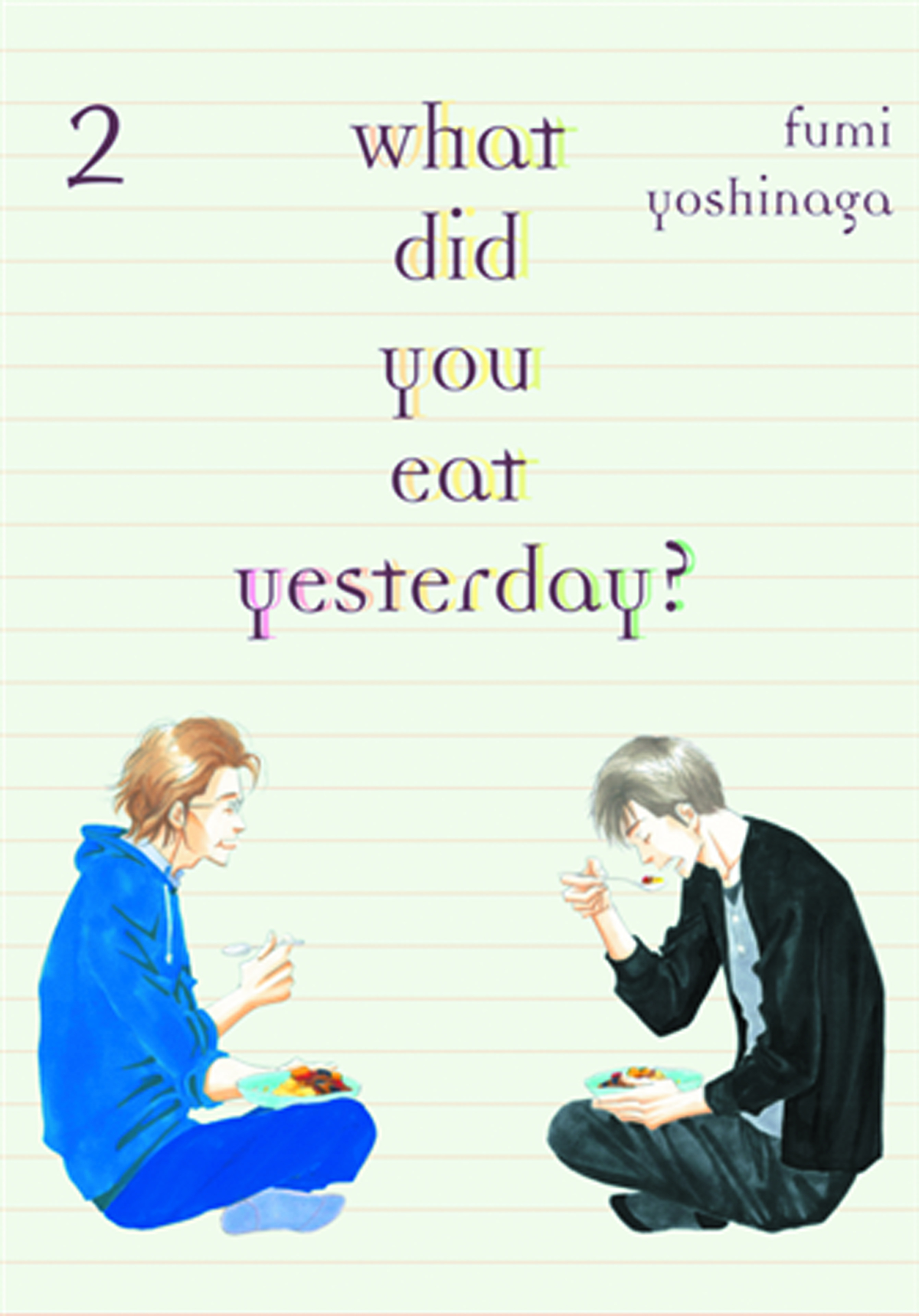
I bought the first two volumes of "What Did You Eat Yesterday" by Fumi Yoshinaga at a con.


It's a manga about a gay Japanese couple in their early 40s, centered around the food they eat. I bought it,

1) because it got recommended with the highest praise, from a friend of mine who actually knows the genre (hi sunriseline!)
2) because it sounded interesting
3) because I knew it would mess with my friends expectations of what I'd buy.

In describing "What Did You Eat Yesterday" to people who actually read the genres in question, I say I like the manga (I keep typing comic) because of the strong character work. And while that's not wrong, those characters, a volume and a half in, are why I'm there, saying "strong character work" feels like a bit of an easy out. I feel like saying "strong character work" is not giving the manga its full due. The pencils are meticulous, the asides are well placed, and the sketches of supporting characters are precise and evocative. The two men in question each have flaws, but also personalities that would interact well. I confess to not being finished with the second volume yet, but what's there so far feels authentic. The descriptions of the food and preparation of dishes reveal character, but also make me want to try my hand at cooking. It's a great manga. If it is not too long, I will purchase it all, like I have with Pluto.

But the more I describe "What Did You Eat Yesterday", the more I feel I'm stepping around the fact that I don't have a vocabulary to talk intelligently about the genre. This is a problem, because in comics, black and white slice of life works are things I actively avoid, much the same with Young Adult material. I have no trouble, when I'm running my mouth of course, passing judgment on those things. And I've got a friend on Twitter (hi Katie Locke!) that loves YA material and will often make the very reasonable point that if I don't read the genre then it makes it hard to pass judgment on its effectiveness or legitimacy as such.


In talking about YA, or Yesterday, or b/w slice of life (hi Adam Witt!), when I am forced to praise them, I talk only about fundamentals. Do you have a plot that's interesting? What motivates the characters? Are the characters compelling? And so forth.  Which, again, feels passing over something politely, or not giving the idea its full respect. I feel my omission.

I can say oh man, China Mieville's a great writer, praise those same fundamentals, but with infinitely more enthusiasm. China Mieville does cool shit. There's monsters! And Serious Ideas! And nightmare fueled panic, white-knuckling an entire final quarter of a novel. I don't have those same things to talk about with ...Yesterday, YA or, b/w slice of life. It is hard to get away from the judgment in my head. To indulge my judgment: What overarching plot is there in "What Did You Eat Yesterday?" Someone, find me some. Really. Go for it. I'll wait. The plot appears to be "a Japanese couple who is gay navigate the labyrinthine code of Japanese formal niceties. Also: Every chapter, a new food dish." That's it.


That's what makes my pleasure in reading "What Did You Eat Yesterday" so striking. I believe I'm having a Nixon goes to China moment here. Enjoying "What Did You Eat Yesterday" and trying to talk about it reveals just how provincial I am. That's the opposite of the how I present myself. I'm looking at my bookshelf right now, it's Faulkner to Foucault to Fuentes. I'm very cosmopolitan. I promise.

(All three Serious, Important Male Authors. I'm aware.)

To say I like "What Did You Eat Yesterday" as a palate cleanser also feels like an omission, a sly insult, as if the stories are not a complete meal on their own. This is a long way of saying I took a chance on something new, and like all great media it rewarded and challenged me in equal measure. I don't know how to talk about this stuff and at bottom, I really ought to.


Been on a Danger Days kick, and while I'm pretty sure I've used Summertime before, I don't believe I've used Vampire Money. Allegedly, a song about turning down a spot on the New Moon soundtrack, and with an opening stolen from Ballroom Blitz. One of the best songs on that record.

Creative Commons License
This work is licensed under a Creative Commons Attribution-NonCommercial-NoDerivs 3.0 Unported License.