Showing posts with label presumptuous young whippets. Show all posts

Tuesday, October 28, 2014

Ignore The Jetsons, Dream Impossible Things

Let's get this out of the way: I doubt anyone reading this at the moment of writing will live to see jetpacks, the way our parents' imagination designed them. Aside from the whole jetpacks shoot flame that will char and destroy your legs bit, the vision of the future is largely understood to be the Jetsons. It doesn't matter that the Jetsons was always highly improbable, it imprinted on the (white) cultural imagination. I must pass over afrofuturism for this whole thing to work.


You have seen this on Facebook. "MAN WHERE'S MY FLYING CAR" and so on into infinity.

But as of October 28, 2014, it doesn't really feel like the future. Unless things get worse, my generation's Selma happened this year, Ebola is back, Russia is posturing on the world stage again and Christ only knows what else will come down the pike with the year 2014 appended to it.

Except, of course, for all the things that watch us from the sky, from the cell phones recording our major moves in our pockets and our social networks recording our minor foibles presumably to be hurled at us when we are cornered or weak. Women get bomb threats for having opinions about videogames.

The future, of course, is always gunning for us. It feels that way in my head.

Except for the margins.

I write this on a laptop computer with 500 gigs of memory, not all of it filled by pornography. I write this listening to a mashup of Aphex Twin and Taylor Swift. It's the mashup that feels like the future. Not in either of the parts, but what that last sentence means.

That last sentence is actually crazy, if given time to unpack it.

1) One no longer needs the imprimatur and recording budget of a big label to make music.
2) Recording technology (and what we define as possibilities for music) has advanced to the point where physical instruments are not always required.
3) The availability of music has gone from requiring a physical copy of the release to a free for all, with almost anything instantly available the day of release, if not before.
4) The ability to manipulate audio that already exists is so unremarkable that it comes standard on a Mac, and similar technology can be found for a steal or a lark on the internet.
5) The ability to record music is so pervasive that it comes standard on a Mac and free versions that do mostly the same thing can be found for a steal or a lark on the internet.
6) The ability to isolate and acquire vocals from a particular recording is available to us.
7) One can distribute what they create for a nominal fee or free, via the internet.
8) The end result is inside a genre that already exists and has a name that fits in our cultural imaginary.

Fifteen years ago, if you wanted to hear music from anywhere else, you had to import a copy of a physical release, which assumes, of course, anywhere else could afford to press it and promote it Today? Troll Soundcloud or Bandcamp for twenty minutes. No promises it'll be any good, but you can hear it.

It may be a shitty punk band you'll be listening to (and I say shitty punk band with solidarity and a smile here) but the option is now available. Something incredible will come. The universe will provide it. Which really means some person will have an obsession and get excited and the technology to create it will exist within their grasp, and the ability to distribute it easily will also exist within their grasp.

As for the content of the music, it's whatever. I never listened to Aphex Twin before, but I thought it was supposed to be weirder and more abrasive than what backs Ms. Swift here. Admittedly, I'm charmed by Ms. Swift's lyrics, even if I hurriedly maintain a jaundiced distance.

It doesn't matter what this mashup is comprised of, what matters is that it can be created, distributed and absorbed.

The takeaway: Music in my lifetime has gone from a thing that I must hunt to find and then purchase to a thing that I can find in a minute and a half if it's particularly obscure and be listening to in 45 seconds after that. Understand that and then multiply it for every other physical medium that yet exists on the planet.

Ten years ago, text messages were becoming interesting. Today? Your phone can record video. Ferguson is Selma, on some levels, but we're different people and we do not require a television channel to broadcast what we see. Now you, dear reader, can find a live feed that's more useful and accurate than CNN. How will that change the way we absorb and weigh information in the future?

Shit, Eleven Names founder Zach plays D&D over the internet with porn actresses. Regularly!

For imperial statements about the future, look to New Scientist or the New England Journal Of Medicine or any military weapons publication. Continuing down this path is a terrible idea, and I did that for an hour until I wisely deleted it.

(The thrust of it: I only have maybe twice my years left again if I'm lucky and the rate of technology currently means that what will be available to consumers the year I die will have existed in a nascent form used by military or random science place for 10 years. Or, put dramatically, the future will end for me in my 60s and it'll take until my 70s for it to reach me.)

And, at least outside of HEY WE CAN CURE [DISEASE HERE] NOW it's hardly ever the technology that is the future, it's what we do with it. The future means women can document the men that harass them using technology available in their pockets. The future means I will still die in fifty years, but I can know and process much more information in those fifty years than my parents and their grandparents were able to.

The future means science fiction is being made obsolete faster than it can be written. The future means everything gets more crowded. Everything gets messier, or we're now aware of how messy everything always was. We are granted more options (if from a fire hose) and more ways of seeing the world. Our ability to make a living on weird or non-traditional jobs has increased exponentially, even if the value of "make a living" is still fairly small. You can express yourself in wild, savage colors.

That last sentence feels too easy. Let me rough that up a little. The future means trans persons may be publicly recognized by my country's administrators while I am alive. When I was a teenager, that wasn't even on my radar, and if it was, I don't think I could imagine their suffrage moving forward at this rate now. Moving beyond the provincialism of my own lifespan, I think we'll be in a better place in terms of recognizing other people in a hundred or so years, even if I only get to contribute to and see the first fifty years of that. I can live with that.

Beyond the old Warren Ellis chestnut "the world's a strange place, let's keep it that way," I imagine, or believe exists a larger sprawl of possibilities at the margins. Look at Homestuck. That's a million dollar property, made entirely by a person from a generation that was native to the internet. Tell someone twenty years ago, you'll see a guy writing a dating sim based on his work on a webcomic, and he'll ask you "what's a dating sim, what's a webcomic and more importantly, no fucking way." We didn't get the future that was in our parents imagination, but what we have currently is something pretty exciting.

We won't get to the Jetsons within my lifetime, I think. But I don't really want the Jetsons now. Do you? How small of a future the Jetsons would be now! How limiting! If all we did was go to the same jobs, but the buildings were taller and the cars smaller!


As I was finishing the major strokes of this at 3 am, I typed in the tags Taylor Swift and it already exists here. I hope and imagine it was Emily or Katrina, from 2010-2011 or a lifetime ago, before the massive needle drop of Phonogram into my life. I don't listen to Taylor Swift or Aphex Twin, but this mashup makes me want to start.
This feels a little too hopeful for me, or I imagine a rebuttal of the terrible things I listed at the top of the article are all still true. It is hard to put a cost on inspiration. It can be done, I am sure, but not by me and not now. I'll say two things. ONE: Access was a major factor in what kept the powerful comfortable and that no longer is true. TWO: Empathy changes lives. What grants more empathy is many different firsthand experiences and failing that, art. I'm a better person for having read Phonogram, but I had to pick my jaw up off the floor after I completed a reading of the Nikopol Trilogy. Borges made me kinder. And if we are not the generation to grapple successfully with the military industry complex, then that makes us like every other generation. But we might gain an inch on it, if we push.

Tuesday, June 3, 2014

What Did You Read Yesterday?

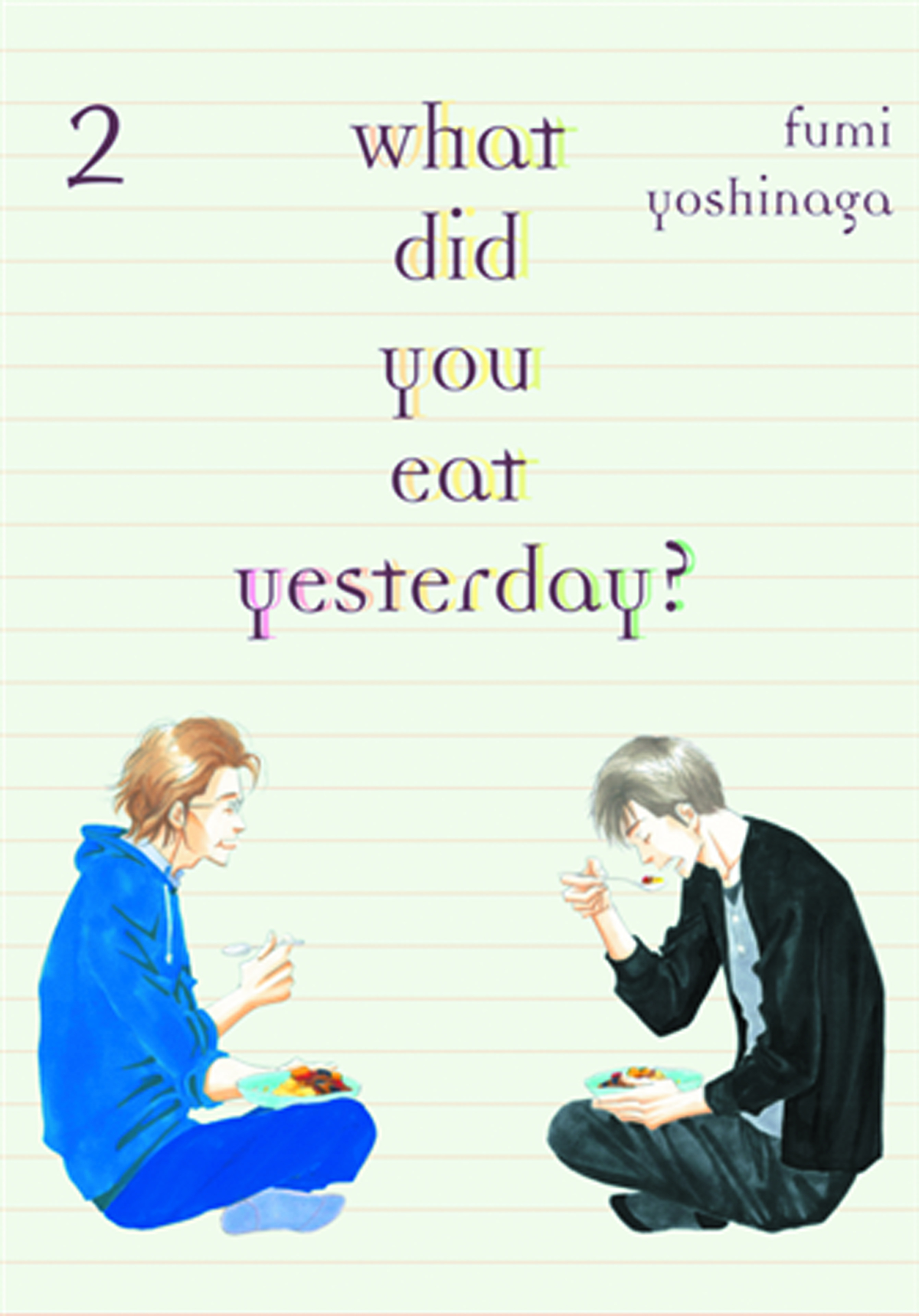
I bought the first two volumes of "What Did You Eat Yesterday" by Fumi Yoshinaga at a con.


It's a manga about a gay Japanese couple in their early 40s, centered around the food they eat. I bought it,

1) because it got recommended with the highest praise, from a friend of mine who actually knows the genre (hi sunriseline!)
2) because it sounded interesting
3) because I knew it would mess with my friends expectations of what I'd buy.

In describing "What Did You Eat Yesterday" to people who actually read the genres in question, I say I like the manga (I keep typing comic) because of the strong character work. And while that's not wrong, those characters, a volume and a half in, are why I'm there, saying "strong character work" feels like a bit of an easy out. I feel like saying "strong character work" is not giving the manga its full due. The pencils are meticulous, the asides are well placed, and the sketches of supporting characters are precise and evocative. The two men in question each have flaws, but also personalities that would interact well. I confess to not being finished with the second volume yet, but what's there so far feels authentic. The descriptions of the food and preparation of dishes reveal character, but also make me want to try my hand at cooking. It's a great manga. If it is not too long, I will purchase it all, like I have with Pluto.

But the more I describe "What Did You Eat Yesterday", the more I feel I'm stepping around the fact that I don't have a vocabulary to talk intelligently about the genre. This is a problem, because in comics, black and white slice of life works are things I actively avoid, much the same with Young Adult material. I have no trouble, when I'm running my mouth of course, passing judgment on those things. And I've got a friend on Twitter (hi Katie Locke!) that loves YA material and will often make the very reasonable point that if I don't read the genre then it makes it hard to pass judgment on its effectiveness or legitimacy as such.


In talking about YA, or Yesterday, or b/w slice of life (hi Adam Witt!), when I am forced to praise them, I talk only about fundamentals. Do you have a plot that's interesting? What motivates the characters? Are the characters compelling? And so forth.  Which, again, feels passing over something politely, or not giving the idea its full respect. I feel my omission.

I can say oh man, China Mieville's a great writer, praise those same fundamentals, but with infinitely more enthusiasm. China Mieville does cool shit. There's monsters! And Serious Ideas! And nightmare fueled panic, white-knuckling an entire final quarter of a novel. I don't have those same things to talk about with ...Yesterday, YA or, b/w slice of life. It is hard to get away from the judgment in my head. To indulge my judgment: What overarching plot is there in "What Did You Eat Yesterday?" Someone, find me some. Really. Go for it. I'll wait. The plot appears to be "a Japanese couple who is gay navigate the labyrinthine code of Japanese formal niceties. Also: Every chapter, a new food dish." That's it.


That's what makes my pleasure in reading "What Did You Eat Yesterday" so striking. I believe I'm having a Nixon goes to China moment here. Enjoying "What Did You Eat Yesterday" and trying to talk about it reveals just how provincial I am. That's the opposite of the how I present myself. I'm looking at my bookshelf right now, it's Faulkner to Foucault to Fuentes. I'm very cosmopolitan. I promise.

(All three Serious, Important Male Authors. I'm aware.)

To say I like "What Did You Eat Yesterday" as a palate cleanser also feels like an omission, a sly insult, as if the stories are not a complete meal on their own. This is a long way of saying I took a chance on something new, and like all great media it rewarded and challenged me in equal measure. I don't know how to talk about this stuff and at bottom, I really ought to.


Been on a Danger Days kick, and while I'm pretty sure I've used Summertime before, I don't believe I've used Vampire Money. Allegedly, a song about turning down a spot on the New Moon soundtrack, and with an opening stolen from Ballroom Blitz. One of the best songs on that record.

Saturday, July 20, 2013

Punk Rock For Young Avengers Fandom

Hello, Young Avengers fandom.

Perhaps you are interested in punk rock. Maybe you read that excellent Freaky Trigger piece about punk rock and Young Avengers and thought, "huh." Maybe you've heard a little before but Kieron Gillen and Jamie McKelvie are getting you more interested. In that case, let me introduce you.

Please.

I'll dispense with the backstory: Nubile white men with guitars a good half century ago figured out you didn't need talent to play music, you just needed anger and momentum.

Punk rock's major contribution to music's history (aside from a reminder to get out before you start to suck) is the idea that an aspiring artist does not require someone else's imprimatur to make music. If someone isn't making the music you want to hear, you are now deputized to make it yourself.

Seriously. If you've got a song in your heart: Write it. Now. This very minute. Stop reading. Go. Do it. Now. Do it.

There's connective tissue between punk rock and comics, if you know where to look. Most obviously, Patrick Kindlon and Matthew Rosenberg, to name two, have released some of my favorite music ever. Mike Cavallaro, known to the Eastern Seaboard as Johnny X from Sticks And Stones, Becky Cloonan, Rick Remender, Jen Van Meter and ad infinitum. Gillen and McKelvie's history with music and a member of punk's extended family, Britpop, is suggested by the above image. It's called Phonogram, there's two volumes and Volume Two, The Singles Club, forced me to confront my fear of dancing. It presented better arguments for dancing than my reasons not to dance.

This is not a history, but a survey. Five songs, cast widely to get a taste in your mouth. If you like it, come back next week. If not, you're only out the time you took to listen to five songs. These aren't my five favorite punk rock songs in the world, but these are five songs which all suggest many of the cardinal directions punk rock moves in. You may hopefully find something you like.

The songs hopefully suggest the focus, the lens, the catalyst and the fuel. There's a Romanticism to punk that I find still useful as I age. There's other parts to punk, the branded nihilism, the clear-eyed hopelessness, but those are doors to go through later on. I still need to get you through this one first.

Like all surveys, it's necessarily incomplete. Emo is a longer story than I have time for and oh God I'm rambling. Five songs. Play loud.


Until I figure out how to embed playlists into Blogger, just go here.

Saturday, July 13, 2013

Metacritic: A Thing I Feel No Guilt About

In a conclusion to a well-sourced feature on the pernicious uses of Metacritic, Jason Schreier wrote something that as a longtime critic, I cannot countenance. He wrote that "[Metacritic is] harmful to critics, who have to deal with PR pressure and the guilt of taking money out of people's pockets."
 
That's wrong and I'll explain why.

 First, last and always: You're a journalist or critic. There's always going to be PR people looking to influence your opinions. It was around before Metacritic, it'll be around after Metacritic. That's the price of the job.
 
Second and more worrisome, it moves the guilt for lost wages or compensation from the people who signed a contract in good faith to the critic who isn't a party to that agreement. Critics are not responsible for a) the contracts that publishers and developers sign b) for a third party's secret interpretation and secret mechanism as to how they collate and weigh an unknown number of reviews, the end result of which they call critical opinion c) the quality of a videogame they didn't make.
 
Guilt is for when I actually did something wrong. Guilt is not for when people who aren't me secretly interpret my thoughts, then though a secret mechanism weigh it alongside 30 other reviews and spit out a number which two parties agree to use for the exchange of money. If developers and publishers want to use that for the distribution of money, the only place I have in that conversation is to remind them reviews are subjective, I am biased and the mechanism they're using changes my language and skews my intent.
 
The critic's job is to have an opinion, write it as clearly as they are able and defend it. The critic's job is to express their synthesized thoughts on an experience, whatever they may be. Good and bad in the same review. Certainty and confusion. Ignorance and knowledge. Transparency and more transparency.
 
This is not to say I am perfect. I have been influenced by PR people. I have failed in articulating my thoughts and I have failed in which ones I chose to publish. That said, critics shouldn't feel guilty for other people's use of Metacritic and anyone who makes them feel they should is not their friend.
 
To presume to speak to Mr. Schreier directly,  the next time someone blames you for not making an incentive because of a delicate score, you tell them you've got some sympathy for them, but that's as far as it goes. And you say it just like that, too, because the contracts signed by developers and publishers are things that are their responsibility, and any guilt they want you to feel is something that gives them cover. Now, if you made a factual error in your review, that's different and that's legit and you fix that. You make damn sure that fix is reflected in the conclusion or score.
 
But your score doesn't take money out of the hands of developers. Deals that make the money developers receive from a publisher dependent on Metacritic (an entity that openly admits to skewing a critic's words) do.


 "The Bride" by Crime In Stereo. I listened to this all of my junior and senior years of college, and not merely for the phrase "your bachelor's won't earn half the debt that you've incurred." It remains poignant today. As an aside, I had to write this blog four times before I got it to where it is now. This one is the shortest, best and most defensible, I think.

Tuesday, February 7, 2012

Life Is Poetic OR Data Recovery And Borges

So, through my own negligence and simply four years of use, my laptop crashed. It wouldn't turn on and when I heard a clak clak claking sound inside the case, I assumed the hard drive had finally had enough of my sophistic bullshit and died honorably.

This computer contained the scattered notes, the half finished drafts, the almost finished drafts, the conversations, the things I thought might conceivably be important for posterity or to take a look back at how I acted back in the day for seven years on. It contained songs, it contained books, .pdfs and whatever else i thought would be cool.

It would suck to lose those things, right? Thus, I went to tech support. (It got fixed, so don't worry about me.)

And it took me about a week or so to get to tech support because my life at the time was a little bit nuts and things had to get done and sleep had to be had and so on. I was slugging my way through Borges' Labyrinths at the time. Labyrinths is set up in three different parts, the largest part, which comprises two thirds of the book, are his incredible fictions, the second part, roughly two thirds of the remainder, is Borges' non-fiction work, and the final part is Borges' parables.

It's Borges' themes that concern us at the moment.

These themes tend to be knowledge imperfectly remembered, knowledge glimpsed once, knowledge forgotten, unnoticed knowledge that sinks into ordinary life or knowledge unrecognized.

I sit, on a train, re-reading the last piece of "A New Refutation of Time" for the fourth time, before I turn the page, trying to make sense of it and the thought pops into my head: Do I want the flotsam of my life back?

Aside from the one interview that wasn't quite transcribed and the current projects, do I really need and would my life be made more profitable by having access to those memories again?

I don't have an answer, but as the train approached the station, I leaned into the sliding door. I also leaned towards no. There would be things I'd miss. Doubtless. But all that evidence of my failures, the remains of the deceptions I was a party to, the bad writing and the record all of my cowardice felt like another extra 40 pounds on my body.

When I thought "I hope it is all lost" it felt insincere, I felt like I was lying to myself as I walking out of the underground. Or maybe the feeling was that I…wasn't strong enough to actually be okay with it. Something Borges wrote armored me, though. There was an essay on Cervantes, in which Borges compared Cervantes to other others, Joseph Conrad and Henry James and what they put in their stories. Borges said the following, which struck me when I first read it: "Conrad and Henry James wrote novels of reality because they judged reality to be poetic."

Walking up the stairs to have my computer to be judged, I know that they're right. Perhaps I could have been reading Phillip K. Dick and that might be slightly more appropriate, but at the time, I was just coming out of a tangle of underground tunnels and platforms, through an visible but unseen maze of human ingenuity and creation. Or as Borges would put it, "[A] labyrinth designed by men and destined to be deciphered by men." This is precisely who I should be reading at that moment.

Those feelings of hardly communicable poetry and discovery of possible connections between the planes of fiction and reality held me. A post-facto moment of glory or madness or presumption: Is this how Borges saw the world?

There were a few parables left in the book. So, after checking in, I sat down on a bench inside and read. I completed the book. I won't say finished because finished is definitive and I get the feeling I ain't never done with Borges. I might set down Labyrinths, but I've got his complete fictions on that same bookshelf and it's many, many pages larger.

I read the last parable and waited.

Eventually, I had to read the same stories again. The ending to "The House of Asterion" gave me an idea, one that I don't have the talent to do all myself, but I have the tools at my fingertips. My mind flared up with two ideas. I see something, but I don't think I can do it. I heard my name called and the cherubic, clean shaven, polite tech support guy gave me the good news: The problem was all in the software, it could be fixed all for free!

Everything could be backed up and I should do that, he says, because your information is important, right?

Oh, of course.

I navigated the maze of public transportation back to my apartment with a spring in my step.

Monday, May 16, 2011

The Common Clearinghouse

Usually, I'm more nuanced than this, but Common's appearance at the White House and subsequent Fox News pants-shitting based on the "burn a Bush" line has only two sides for me: You either understand Common's rhymes in the context it was written and then compare that to his entire discography or you don't. This is one of the few times where black OR white thinking is completely correct. There's right and there's wrong. It's clear, Fox News is on the second side.
Oh, and this is obviously manufactured outrage. No one ought to be surprised.

(Also: I use rhymes here as opposed to lyrics not because I want to devalue the message in hip-hop, but I instead don't want to use rock parlance to describe hip-hop where I don't have to.)

The song that got Fox News' knickers in a twist, "A Letter To the Law", based on its last part is, explicitly, about moving beyond that kind of violent language and rhetoric the news organization took for the song's core aim, to make a better, more safe world as a community. Period. There is no grey area on this one. I accept none. So let's use this as a test: Are you for Common or Fox News? Life hardly ever gives us these clear choices, these easy distinctions between knee-jerk crank yankerism and you know, truth, bolstered by accuracy. Take this moment and hold onto it.

Side point: Since when does anybody, for any reason, go to Fox News for any meaningful critical dissection of art? Seriously: When was the last time you or any of your friends thought "There's a new record from [Artist H] coming out. What does Fox News think of it?"

Then, Ron Grossman wrote in the Chicago Tribune an idiotic op-ed with the point that hey, Common, as a rapper, is not a poet. And his poetry isn't really that good. He's certainly no Keats, and thus Common ought not to be mistaken for a poet. To support his point, he chose the line I'm a renegade. I ain't never been afraid, I'm fresh and gettin' paid.

Now: Let's ignore the Grossman sheltering himself in his description of himself as a fuddy-duddy. I'll get to that later. What he's doing is using a particularly, say, bad line of Common's and saying it's indicative of the quality of his rhymes. It's not, of course. I don't even listen to Common and I can smoke this guy. Here. I spent an entire...3 minutes on rap genius and found this one: so many raps about rims, I'm surprised niggas ain't become tires.

The genius of rap genius is that you can click on the rhyme itself and get the explanation of it, sooooo, when I click on that, here's what comes up: [Common]’s surprised that even after rapping about rims so much, people aren’t tired of it. Also, play on the words raps/wraps. What wraps around a rim? A tire, of course.

That is some wordplay that Grossman dismisses entirely. Shit, most of rap's best lines are double, triple and quadruple-entendres that you need to be in the community to get. And pursuant to sharpening my point, I don't even listen to that much hip-hop! The two I listen to most often are Dessa and P.O.S., not exactly Hall Of Fame material. I don't even LISTEN to Common! I know he's Kanye's friend from Chicago that isn't Lupe Fiasco. I bought one of Common's CDs, Universal Mind Control, for my brother, for Christmas. That's it. That's the extent of my Common knowledge.

Now: Let's get back to the point about Grossman sheltering himself in the phrase fuddy-duddy. He's old. He doesn't understand kids these days. It's a phrase to give him wiggle room, to show that, well, he might not have everything right, but he has the gist. Fucking wrong. If he's going to call out Common for being bad with language and saying he's an old teacher, then he should at least have the temerity to back up his "Common isn't Keats because Common occassionally writes lyrics that are putrid" statement with his full authority. Plus, I'm Keats wrote subpar stuff and it doesn't get collected with his best work. Why not the same for Common?

And, finally, a recursive point, independent of Common's ability as a poet, just because he's bad doesn't make him not a poet. One can do things and be bad at them. What all of this boils down to is vivid: Common's getting a lot of flak that he simply does not deserve. That it is this simple is something that does not happen terribly often.


This song is by Common. It's called the Corner. It's about the corner and its importance in black culture. Enjoy.


Friday, December 3, 2010

...But We'll Find It Again

Wednesday's and today's title are related. They're a Much the Same lyric, at the end of their fantastic record called Survive. Survive is a deliciously old-school skatepunk record, with modern production and some the best lyrics involving cell phones I've ever heard.

The song itself (Picking Up The Shattered Pieces) is about trying to rekindle love, but since I'm such a romantic I'm seeing other things in it. I leave for the States in a couple days (six) and it's dawning on me, what I'm going to find when I get back. I'm going to find my cell phone, a voice I haven't heard in three months and I wanna see if I can stretch that out to four, a couple friends from college, a kid I used to hate from college, the bitter, grey city I swear I love but have lived in too long, the Starbucks on the corner, the bar, the "low" music, the high culture, the museums, the boredom, the terror and the self-loathing mixed with self-pity.

I'm going back to behaviors, that for better or worse are comfortable or fundamentally obscene. I remember hearing (whether this apocryphal or not, I don't know) the phrase getting comfortable with being uncomfortable when I was going out on college visits. I'm not sure that's true now, but instead that I accept the discomfort as a part of the machinations and gears of life.

And part of the mechanisms is writing. I get a sick sense of pride in how I write. It has a rhythm. I've chosen to write in a style that (hopefully) is hard to mimic. If the paper isn't in the same tone, teachers will know. I write in a way that leaves a mark that is apparently fun to read. Because having a distinct voice and having it be terrible isn't that good. I mean, it at least can be improved through work, but does anyone want to be known for having a style that's more abrasive than it is pleasurable? I don't.

Also, I sipped some tea under the vast expanse of powder blue sky, trying to figure out what I wanted, when it hit me: This is December. Grim, harrowing, austere December and I'm outside with my wet hair, a royal blue Descendents longsleeve and a pair of jeans. This is pretty nice.


This is Picking Up the Shattered Pieces, the song I was referring to. A live version, because it doesn't have random minutes of not-music at the end of it. Plus, it's uploaded by the singer. Also: I wanted to end on a positive note, since I don't think I have in a while, and this is pretty nice sums up everything I want to say.

Wednesday, November 17, 2010

A Shot At the World

My perspective on philosophy is very, very simple: Make it applicable.

I presented a little bit of Gramsci in a class and tried to go in a different direction, which worked sometimes and didn't at others. I made it personal. Like, painfully so. We are the consequences of our actions and the influences of the people we've gathered around us, yes? So I asked, what behaviors have rubbed off from former lovers and that immediately focused their attention. Human nature is a process, yes?

Human nature is in the little things we do or don't. The tiny bits we get comfortable with, like crossing our legs or tapping our fingers on the desk. I don't view it as something grand, then. If you want to see human nature, don't just look at things like having to die, but also whether you urinate in the shower or your body language while ordering coffee.

According to Gramsci, human nature is something learned, not solely something installed on the harddrives of our psyche by our extraterrestrial creator. (Yes, God and computers. It's a bit of a cliche, isn't it?) But I looked and I saw open eyes and even a look of shock on a couple faces. when I applied it to a domestic point. Something snapped into place behind their pupils and watching that transpire is a feeling that's better for my soul than a hundred mental health days.

That's what philosophy ought to be. It ought to be something that shocks and surprises, like going through a haunted house from the inside out. It should implore its practitioners to ask deeper, more probing questions and for a brief moment, it might have. This all is very idealistic. In this case, it's my idealism and that makes all the difference. (It doesn't.)

It was that granular applicability that made the point corporeal, powerful and frighteningly useful. Given a little more time, the discussion (a kid just admitted that he took his parents lives for granted, for God's sake!), cut off, could have been interesting. It wasn't to be, but I got something special out of it nonetheless. I got a single moment of clarity, an instant of demystifying power against a lake (not an ocean or sea) of unimpressed faces. I could get used to that.


I am listening to a lot of Thursday, in quantities that I never did before. A City By The Light Divided has been keeping me company, but it's War All the Time that I listened to through first. Asleep in the Chapel is off War All the Time, and it's strange in that when I don't pay attention, I like it more. But when I try to describe why, I can't. The verses are so good, the chorus less so. Plus, it uses the phrase "sing hallelujah", which almost always scores good marks in my book.

Monday, November 8, 2010

Blue Monday

No real good news from 2666. I'm now 574 pages done (with an entire book left to go after this one) and...it's more of the same. It's well written, but...hopefully, now, I'm spinning even closer to the center. One major character is going make an announcement to the press, but that's a process that's taking forever and in the meantime, the female bodies, some mutilated, some not, accumulate.

Still a lot of women dying. The sheer number, unrelentingly, who all, somehow, work at maquiadoras is staggering and it can't be stopped. Police are incapable of finding the killers and even if they could, corruption, laziness or simply just not having enough resources available to do the job abounds, with many of the investigators chauvinist pigs. The women, almost exclusively, are referred to by the police as whores, or even if they're confused and went out with a guy and it ended with their death, they're still tarred by that, somehow.

It's not so bad, one of the characters says, at least in Santa Teresa, more women, than in other parts of Mexico, have jobs.The maquiadoras provide the jobs, and are temples, themselves, as if the young women are constantly scarified on it to keep the town and workplace going. The women pay the price for the Mexican lifestyle, in which the rage, jealousy and loathing of men is paid to their spouses or girlfriends accounts. She was cheating on me, so I killed her. She wanted a little space, so I strangled her. Drugs are often involved.

We see the men on their own without the women in prison, and there's…at least two counts of prison rape which get graphic and makes me physically uncomfortable.

This book feels like it's got a political undercurrent, even though there's…nothing explicitly political here. But, if we're to take Gramsci's ideas at face value, that recognition is the first step to action and has value, then there is a reasonable argument that Bolano, by showing the myriad ways women get killed and how little happens, is making his point about how women are treated today and how casually news of their deaths is received.

Their deaths are oppressive and constant. I can only imagine what it's like, in every meaning of the phrase.


We Are the Pipettes is a song by the Pipettes. It's the first track off their disc of the same name. Light song, hopefully, to counteract the depressing post.


Wednesday, September 22, 2010

Me and John Rawls Down By the Schoolyard

Titles aren't always great. Sorry.

Much of what I read was preface. Someone said it takes a philosopher a couple paragraphs to clear their throat and there's at least 10 pages of throat clearing before the main feature starts. Admittedly, it's an explanation of the changes made for the 1999 revision of the book published in 1971.

And, honestly, it's kind of impenetrable to me. I don't think I got as far as the parts that were revised, so I can't tell where a difference was made. The preface also sees Rawls talking about the changes he would have made to the book had he written it now, which include Chapters II and III. As an editor, it almost makes me want to scream. If a book is going to be reissued, especially in the case of a book that has a shadow like a crater in Hiroshima, then give the author the opportunity to revise it completely.

Then I look again at the reissue date: 1999. Printers and word processing programs were not as ubiquitous as they are now. And even if they were, maybe it was too much work for the aging Rawls. There might not be enough hours in the day for him to devote to a revision that sizable. It might not even be the same book.

In the words of my spiritual adviser, X-Man Bobby Drake, that's probably a thing, right?

(Then again, when the first edition of the book has a printing for the sole and express purpose of students seeing what mistakes were made in it, there's a precedent set.)

On a third hand, just doing a book with a word processor is hard enough, let alone a 500+ page tome where you need to connect every goddamn dot, leave no link in the chain unattached and do so when word processing programs and computers are only really coming into not exclusively techy use. Shit, this book that has not just defined its field, but made an entire other one in critical commentary, was written on a fucking typewriter, if not by hand.

Think about that. Now think harder. I can't even write 50 pages on Word without changing topics, so writing 500+ on a typewriter or by hand is as foreign to me as our favorite extra-terrestrial, Galactus, Devourer of Worlds. And, it's not like their jobs or responsibilities go away when they're writing, unless they've got grants. Sorry, this idea is mindblowing. I'm writing this on a word processor, with like 4 printers within a 45 second walk. How do you even review a chapter, just to cast another eye on it?

Anyway, the book get to the thesis pretty quickly: Justice as a social scheme, is to be understood as how rights and privileges are distributed. This would be arrived at from the original position, a position that sees people, without knowing how they would fare in the lotteries of birth, ordering a society. Rawls believes it is reasonable for human beings to protect the downside, to use a colloquialism, if they don't know how life is going to turn out.

It's called the veil of ignorance. From behind that veil, Rawls believes that human beings would freely and rationally choose to order a society where the minimum standard is as high as possible, because he believes they'll believe the odds are they're gonna be near it. I'm only four chapters into it, but the idea that jumps out to me is that this presupposes a level of education between all parties that may not be equal.

Aside from that, I don't have much else to say about the first four chapters. I'm a B.A., and this all makes sense to me, with enough re-readings. I'm capable of synthesizing and analyzing information, but...damnit. I don't want to sell myself short here, but this is a stone cold classic that makes a bit of sense at least in the first four chapters. I mean, sure, one could choose to gamble and argue that the baseline should be set lower, with more opportunity to accumulate wealth and advantages. But that's a point other people made that I read about.

That is the point of this feature, to go and see what, if anything I find, synthesizing regularly. 2666 next week! Somehow, that's the easier book to read. Who knew?


I've been listening to Katy Perry's song Teenage Dream non-stop. Here it is, to stand, happily in defiance of the super-abstract and unfun Rawls. Love the dissonance, folks.

Creative Commons License
This work is licensed under a Creative Commons Attribution-NonCommercial-NoDerivs 3.0 Unported License.